
REVIEW · DESSERT TOURS
Private Traditional Coffee And Dessert Making Activity
Old recipes make better souvenirs. This private Gyumri activity pairs a small museum visit with hands-on Armenian coffee and dessert making, giving you a tasty way to meet local culture. I especially like the chance to prepare ghayfa, a nearly forgotten roasted wheat drink, and the use of antiques saved by the host team. The main drawback is simple: the venue sits a little outside central Gyumri.
You pay $30 per person for about an hour, with only your own group taking part. That makes this a friendly choice for families, couples, and small groups who want more than a quick tasting. The short time means you should expect a focused introduction rather than a full cooking course, but you still get to make and eat your own sweets with coffee and tea.
Key points at a glance
- A museum visit comes first: See antiques from the Russian Empire period and a large collection of historic Gyumri photographs.
- Ghayfa is the unusual drink: Learn to prepare roasted wheat coffee, a local drink that has nearly disappeared from everyday use.
- You choose one dessert: Pick from yaghli, bishi, shakar lokhum, or bagharj.
- The food is hands-on: A local chef guides you while you prepare the coffee and dessert yourself.
- Antique tools add character: The utensils used for cooking and eating were carefully saved by the team.
- Private does not mean rushed: Your group receives the experience alone, though the full activity lasts only about one hour.
A Gyumri food experience with a story behind it
Gyumri is a city where food, family life, and memory often sit close together. This activity gives you a compact look at all three. You begin at Chalet Gyumri on Movses Khorenatsi Street, enter a museum and guest house, and then move from old objects to old recipes.
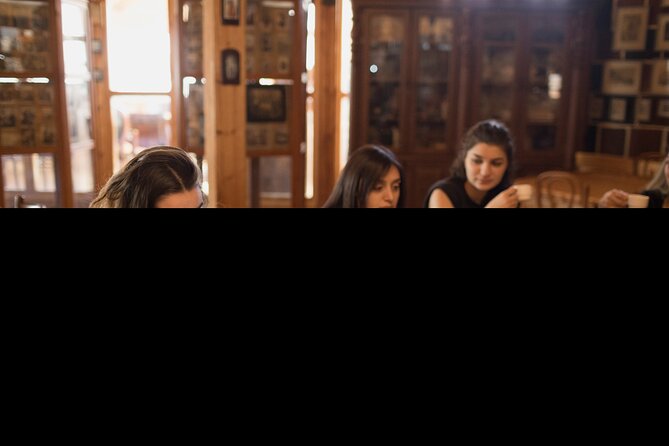
That order matters. The museum gives the food a setting. Instead of making a sweet with no context, you first see household objects and photographs tied to Gyumri’s past. The collection includes antiques dating as far back as the Russian Empire, along with what is described as the largest collection of historic photographs of Gyumri.
I like this combination because it avoids treating Armenian food as a simple cooking demonstration. You get a glimpse of the people and homes connected to the recipes. Then you use carefully preserved tools to make food that is still connected to local life.
The experience is private, and that helps. You do not need to compete for the chef’s attention or watch from the back of a large group. If you are traveling with children, older relatives, or friends with different levels of cooking skill, a private format lets everyone work at a comfortable pace.
The tradeoff is the one-hour duration. You will not learn a long list of dishes or master Armenian pastry technique in that time. Think of it as a compact cultural activity with cooking at its center, not a serious culinary workshop.
More Dessert Tours in the world:
- Award Winning Farm Tour: Coffee, Chocolate and Unique Gifts
★ 5.0 · 484 reviews - Vienna Coffee, Cake & Pastries Tour with Local Stories
★ 5.0 · 470 reviews - Buggy Ride Into the jungle with cave coffee & chocolate tasting
★ 5.0 · 465 reviews
The museum sets the table
Your visit starts with the museum portion. The display includes antiques from the Russian Empire era and a substantial collection of historic images from Gyumri. The available details do not list every object, so you should not expect a room-by-room museum catalogue, but the collection clearly provides more than decoration.
This stop is useful for understanding why the cooking tools matter later. The team has saved antique implements for both preparing and serving the food. You are not simply handed modern equipment while someone talks about tradition. The objects help connect the recipes to earlier household routines.
The historic photographs are another strong feature. Gyumri has changed over time, and images give you a way to see the city through its people and streets. For visitors spending only a short time in town, this can add context that a standard food stop often misses.
You should allow yourself to look closely before the cooking begins. The activity is only about an hour, so the museum visit is likely a concise introduction rather than a long guided tour. Still, it gives the experience a sense of place that a restaurant meal cannot provide.
Making Armenian coffee and nearly forgotten ghayfa
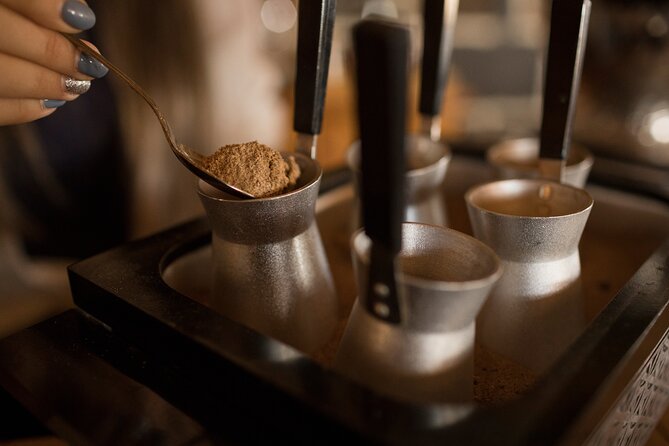
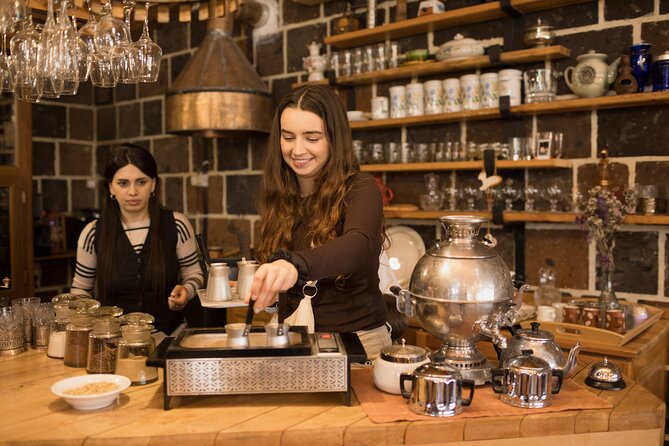
After the museum, you begin preparing the drinks. Traditional Armenian coffee is one part of the lesson, while ghayfa provides the more unusual story.
Ghayfa is a roasted wheat drink that was once popular in Gyumri but is now almost forgotten. That makes it especially worthwhile for anyone interested in local food traditions. You are not just learning how to make a familiar coffee in a different setting. You are being introduced to a drink that may otherwise be difficult to encounter.
The supplied details call ghayfa a barley coffee in one description, while the main explanation identifies it as a roasted wheat drink. Either way, it is presented as a grain-based beverage rather than ordinary coffee. Pay attention to the preparation and the explanation of its place in Gyumri life.
The coffee and drinks also serve a practical purpose. They are enjoyed with the dessert you prepare, so the activity has a clear finish: make, sit down, and taste. That is more satisfying than preparing food that disappears into a kitchen while you wait.
You may also receive tea with the sweets. The exact serving details can vary, but the experience is designed around sharing what you have made. I consider that important because Armenian hospitality is expressed through the table, not just through a cooking lesson.
Choosing one of four traditional desserts
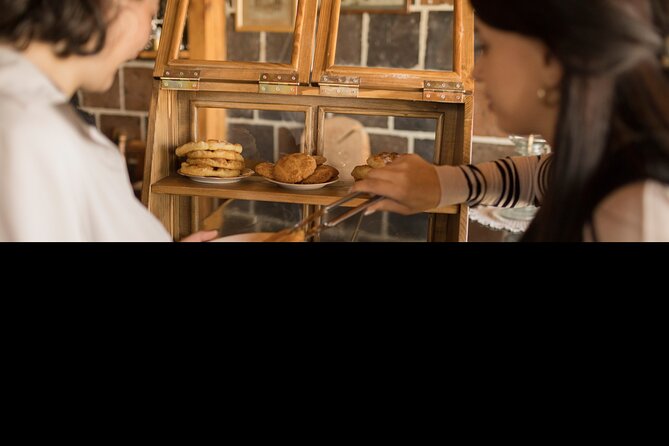
The central decision is which dessert to make. You choose one of four options, and each offers a different glimpse of Armenian home baking.
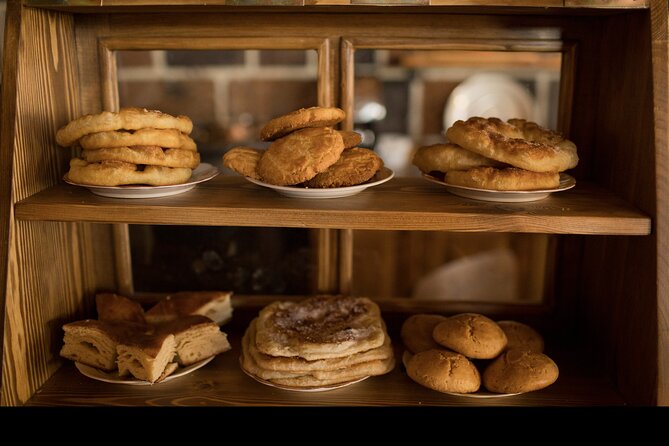
Yaghli consists of thin layers of dough and oil. It is fried and topped with sugar. If you like crisp, sweet pastries, this may be the most direct choice. The use of thin dough also gives you a chance to see how a simple set of ingredients can produce a distinctive texture.
Bishi is a yogurt-based pastry. It is fried and eaten with hot chocolate, giving it a richer and more playful presentation. This pairing may appeal to families and anyone with a serious sweet tooth. The details do not specify the full preparation method, so expect guidance from the local chef rather than a recipe you can complete independently from memory.
Shakar lokhum is an oily, sweet cake baked in the oven. Its name and style mark it as a different kind of treat from the fried pastries. If you prefer a baked dessert, this is the obvious selection.
Bagharj is another yogurt-based pastry. It can be made sweet or salty and is decorated with intricate designs. This is perhaps the most flexible option, especially if your group does not want every item to taste like dessert. The decoration also adds a visual element to the activity, though the time available means you should not expect elaborate professional pastry work.
The choice makes the lesson more personal. You are not forced into one recipe, and you can pick based on taste, texture, or curiosity. If you are sharing the activity with a group, decide in advance if everyone will make the same item or if the host can accommodate different choices. The information confirms a choice of one of four desserts, but does not spell out whether each person may select a different one.
More Private Experiences in the world:
- Private Walking Tour, Food Tasting and Bosnian Coffee in Sarajevo
★ 5.0 · 255 reviews - Salento: Private Cocora Valley, Salento & Coffee Farm Tour
★ 4.9 · 202 reviews - Private Coffee Roasting Class
★ 5.0 · 101 reviews - Coffee & Chocolate Private Tour in Medellin: Genuine Experience
★ 5.0 · 100 reviews
Local ingredients and antique kitchen tools
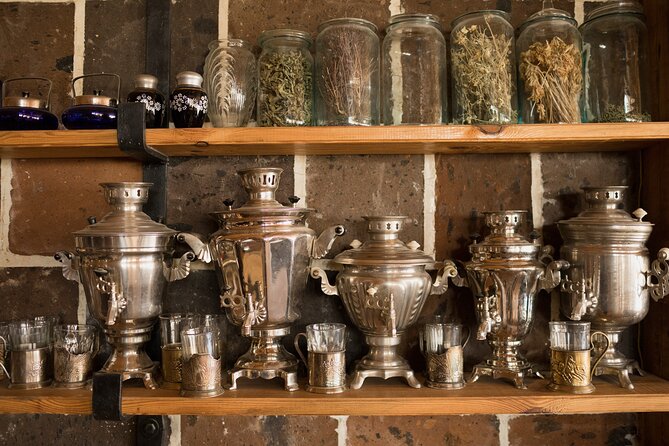
Most of the ingredients come from the host team’s local farm. That detail gives the food a stronger connection to the area, even though the exact farm location and ingredient list are not provided.
You should not expect a farm tour. The value is in knowing that much of what goes into the recipes is locally sourced, rather than treating the dishes as generic demonstrations. It helps explain why these foods are presented as local specialties instead of simply old-fashioned sweets.
The antique tools are just as important. They were saved by the team and are used for making and eating the food. This gives the activity a tactile quality. You are handling objects with a history, not only hearing about tradition in abstract terms.
Of course, antique tools may not work like modern kitchen equipment. That is part of the charm, but it may also mean the chef does more of the delicate work or steps in when needed. The activity is designed for participation, not for you to work without help.
The presence of a local chef is reassuring. You are not expected to know the technique before arriving. The chef guides your group through the process, explains what to do, and helps turn unfamiliar ingredients into something you can eat within the short session.
Why the private format matters
A private activity can be worth more than a large group class even when the duration is brief. You get the venue, chef, museum visit, and cooking time for your own party. That makes it easier to ask questions and to include people who may not be confident around food preparation.
The format also suits different age groups. One of the strongest positive points is that the experience works well for all ages. Children can take part in shaping or decorating where appropriate, while adults can focus on the cultural background and the unusual drink.
You should still keep expectations realistic. The activity is not advertised as fully accessible for every physical need, and no detailed mobility information is provided. Service animals are allowed. If someone in your group has specific access requirements, contact the provider before booking rather than assuming the antique setting will be easy to navigate.
The private setting may also help if you are visiting Gyumri with a small family group and want a quiet indoor activity. Cooking, tea, and conversation can make a welcome change from a day of walking, especially in poor weather. The activity ends where it starts, so you do not need to arrange a separate return transfer.
Is $30 a fair price?
At $30 per person, this is not merely a pastry purchase. The price includes an approximate one-hour private experience, the museum visit, instruction from a local chef, the ingredients, the selected dessert, and the drinks you prepare and share.
For a large group, group discounts may improve the value. The details do not state the discount amount, so ask about the final per-person rate before you commit. For a couple, the private format and museum element make the price easier to justify than a simple coffee and cake stop.
The value is strongest if you care about context. If all you want is a cheap snack, this will cost more than buying a pastry at a bakery. If you want to understand a nearly forgotten drink, handle saved household tools, and make a traditional sweet in a private setting, the cost is reasonable.
The one-hour length keeps the commitment easy. You can fit it into a day of sightseeing without giving up half your schedule. On the other hand, the short session limits the amount of cooking you can do. You are paying for a focused cultural encounter, not a long, skill-building class.
Getting there and planning your visit

The meeting point is Chalet Gyumri, at Movses Khorenatsi Street in Gyumri. The venue is a little off-center, so plan your route before the start time. The supplied information does not provide transport details, walking time, or parking information, so do not assume that the venue is directly beside the main sights.
A mobile ticket is offered, and confirmation arrives when you book. The activity is available in English, which makes it suitable if you do not speak Armenian or Russian. Since the experience is private, you will not be relying on a large group guide to translate explanations from a distance.
Bookings are commonly made about 22 days ahead. That is a useful sign that you should reserve early if your Gyumri schedule is fixed, especially if you are visiting during a busy period. You can cancel for a full refund up to 24 hours before the local start time. Changes or cancellations inside that window are not accepted for a refund.
Who will enjoy this most?
I would recommend this to you if you like food with a local story. It is especially suited to:
- Families looking for an activity that suits several ages
- Couples who want a private indoor experience
- Small groups interested in Armenian customs and home cooking
- Visitors curious about lesser-known drinks such as ghayfa
- Anyone who prefers making a dish to simply ordering one
- Museum fans who enjoy objects, photographs, and domestic history
It may be less suitable if you want a full cooking course, a central city location, or a long meal. The museum collection is a major part of the appeal, but the visit is brief. You should also choose this activity for its atmosphere and cultural detail, not because it promises a large quantity of food.
Should you book the Gyumri coffee and dessert activity?
Yes, if you want a short, personal introduction to Armenian food traditions. The strongest reasons to book are the forgotten roasted wheat drink, the choice of four unusual desserts, the antique tools, and the warm private format.
I would place it high on a Gyumri list for families and small groups. The only real cautions are the off-center address and the one-hour limit. Arrange your transport, arrive ready to take part, and choose your dessert with care. At $30 per person, it offers good value when you treat it as a museum visit, cooking lesson, and shared tasting in one compact experience.
FAQ
Where does the activity take place?
It takes place at Chalet Gyumri on Movses Khorenatsi Street in Gyumri, Armenia.
How long does the experience last?
The activity lasts approximately one hour.
What drinks will I learn to make?
You will learn to make traditional Armenian coffee and ghayfa, a roasted wheat drink that was once popular in Gyumri and is now nearly forgotten.
Which desserts can I choose from?
You can choose one of four desserts: yaghli, bishi, shakar lokhum, or bagharj.
Is the activity private?
Yes. Only your own group participates in the activity.
Is the experience offered in English?
Yes, it is offered in English.
Can I cancel for a full refund?
Yes, you can cancel up to 24 hours before the local start time for a full refund. Cancellations or changes made less than 24 hours before the start are not accepted for a refund.
Just added around the world
- Vietnamese Coffee Making Class in Hoi An★ 5.0 · 4 reviews
- Venice Delights: Coffee & Food Experience Walking Tour★ 5.0 · 2 reviews
- Yerevan: Private Coffee Tour with 2 Café Stops★ 5.0 · 2 reviews
- Vietnamese Coffee 101 Workshop★ 5.0 · 11 reviews
- Ubud: Waterfall, Holy Water Temple,Swing&coffee plantation★ 5.0 · 9 reviews
- Vancouver: Street Art & Craft Coffee Walking Tour w/ Tasting★ 4.8 · 11 reviews
- Vienna: Guided Viennese Coffee-House Tour★ 5.0 · 2 reviews
- Coffee pleasure walking tour★ 5.0 · 12 reviews
Dessert Tours, compared.
Award Winning Farm Tour: Coffee, Chocolate and Unique Gifts
Read our review →
Vienna Coffee, Cake & Pastries Tour with Local Stories
Read our review →
Buggy Ride Into the jungle with cave coffee & chocolate tasting
Read our review →
ATV Adventure w/ Chocolate, Coffee & Cave Swim in Punta Cana
Read our review →
Coffee & Chocolate Private Tour in Medellin: Genuine Experience
Read our review →
Coffee & Chocolate Tour+Sloths Park & Llanos de Cortez Waterfall
Read our review →
ATV OR BUGGY Ride Into the jungle with cave coffee & chocolate
Read our review →
Browse the lists this tour appears in