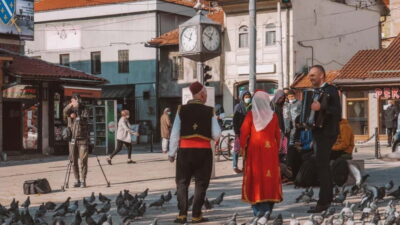
REVIEW · BOSNIA AND HERZEGOVINA COFFEE TOURS
Sarajevo Old Town: Bosnian Coffee, Baklava & Panoramic Views
Sarajevo tells big stories in small streets. This local-led walking tour links the city’s Ottoman, Austro-Hungarian, religious, and wartime landmarks with Bosnian coffee, traditional sweets, copper work, and a wide city view. I like the mix of serious history and everyday culture, especially the chance to pause in a local café instead of racing from monument to monument. I also like that guides such as Dijana, Daniella, and Amela have been praised for explaining everything from architecture and customs to Sarajevo’s wars in a warm, personal way.
The main consideration is the amount of walking. The route takes between 150 minutes and three hours, with many stops packed into a compact city center. You should wear comfortable shoes and dress for the weather. The tour covers a lot, so anyone wanting a slow, highly detailed visit inside each building may find the pace brisk.
Key points to know before you go
- See Sarajevo’s religious mix in one walk: The route passes the Orthodox Cathedral, Sacred Heart Cathedral, Emperor’s Mosque, and Gazi Husrev-beg Mosque.
- Understand the Sarajevo Assassination: At Latin Bridge, the guide explains the event involving Archduke Franz Ferdinand and Sophie that helped trigger World War I.
- Taste coffee the Bosnian way: A 20-minute café stop includes traditional Bosnian coffee, with time to try local sweets such as baklava.
- Try Sarajevo’s copper tradition: In Kazandžiluk, you learn about roughly 500 years of copper crafting and may try the craft yourself.
- Finish with a broad city view: The final viewpoint gives you a useful sense of Sarajevo’s setting after walking through its close-packed center.
- Pay $20 for a strong introduction: The price includes the guide, coffee, and panoramic stop, making this a sensible first-day orientation.
Starting at the Eternal Flame
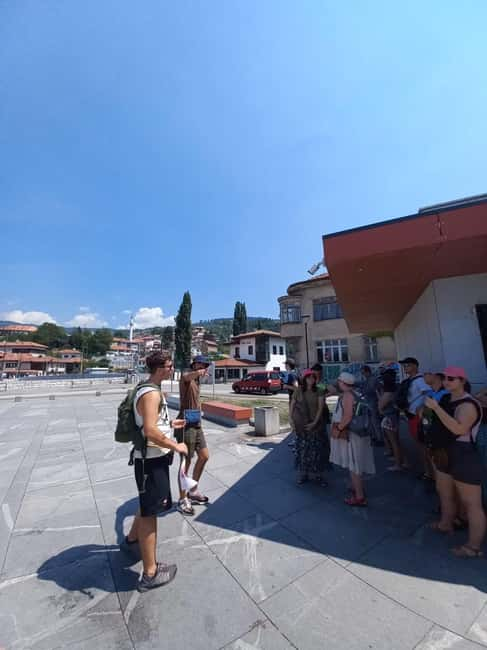
Your walk begins at Vječna vatra, the Eternal Flame, at 10 a.m. for the regular public tour. Look for a guide wearing a Sarajevo Experiences T-shirt or carrying a Sarajevo Experiences umbrella.
This is a smart meeting point because the Eternal Flame sits in central Sarajevo and gives the tour an immediate historical opening. The flame commemorates those who died during World War II, so your introduction begins with the city’s experience of conflict and remembrance rather than with a simple photo stop.
You then move through the main streets and squares on foot. The route is designed to show how Sarajevo changes from its more Austro-Hungarian-looking center into the Ottoman-era lanes of Baščaršija. I like this structure because you can feel the city shift as you walk, not just hear a list of dates.
A few more coffee tours around the world worth a look
- Hanoi Coffee Experience: 6 Brews, 9 Recipes & 3 Liquor Tastings
★ 5.0 · 2,945 reviews - Medellin: Coffee Tour with Transport, Snacks and Tastings
★ 4.7 · 1,357 reviews - Istanbul: Turkish Coffee Making and Fortune Telling Workshop
★ 4.9 · 1,308 reviews
The market, cathedrals, and Sarajevo’s meeting point
The City Market Hall is one of the early stops. It helps place Sarajevo’s daily life beside its grand public buildings. Your guide can explain how the city’s food, trade, and social habits fit into the larger story.
The route then reaches the Cathedral Church of the Nativity of the Theotokos and the Sacred Heart Cathedral. Seeing both Orthodox and Catholic places of worship in the same walking tour gives you a quick way to understand Sarajevo’s religious variety.
At the Sarajevo Meeting of Cultures marker, the change in the city becomes especially clear. This point marks the meeting of different architectural and cultural zones. It is a useful place to pause and notice that Sarajevo is not a single-style city. The Ottoman and Austro-Hungarian influences sit close together, often within a short walk.
The guide’s role matters here. Amela has been praised for explaining both the cooperation among Sarajevo’s religious communities and the pain caused by war. That balance is important. The city’s story is not only about picturesque streets or famous buildings. It is also about how people have lived together, suffered, and kept going.
Latin Bridge and the event that changed Europe
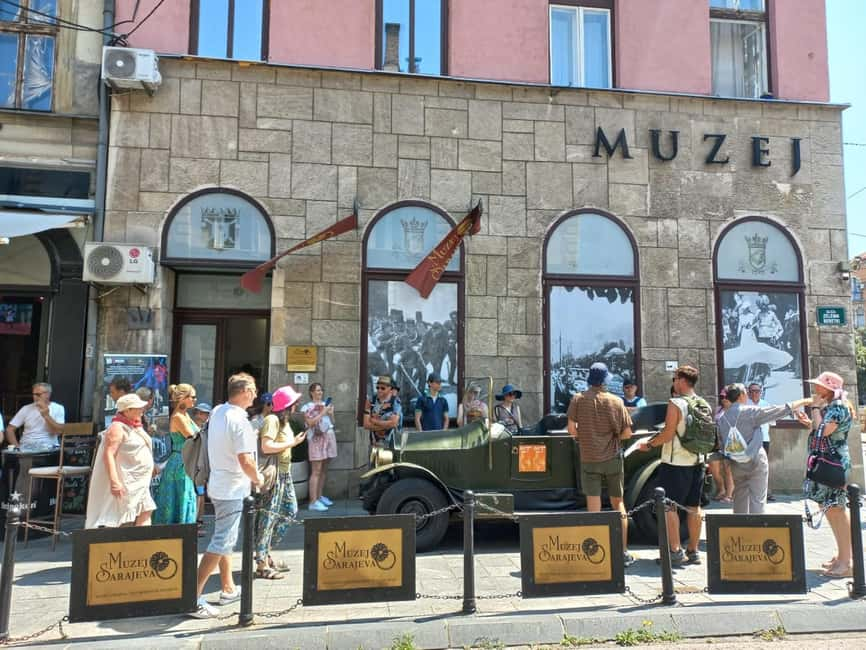
Latin Bridge is one of the most important historical stops. Near here, Archduke Franz Ferdinand and his wife Sophie were assassinated in 1914. The event helped set off the chain of events that led to World War I.
A good guide will help you see this as more than a single dramatic moment. The location is part of an ordinary city street, which makes the story feel immediate. You are not standing at an isolated battlefield or a grand palace. You are standing in the middle of Sarajevo, where local streets became part of world history.
This stop can be especially valuable if you know only the basic version of the assassination. Your guide can connect the event to Sarajevo’s political and cultural setting. Do not expect a long academic lecture, since the tour has many more stops ahead, but you should leave with a clearer picture of why this spot matters.
Emperor’s Mosque and Gazi Husrev-beg Mosque
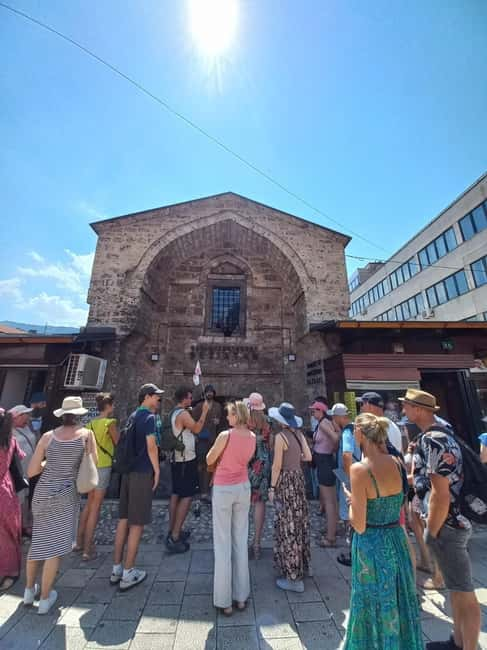
The walk continues to the Emperor’s Mosque and Gazi Husrev-beg Mosque. These stops bring you into Sarajevo’s Ottoman past and show why the city feels different from many other European capitals.
Gazi Husrev-beg Mosque is especially important to Sarajevo’s identity. The stop is not just about photographing a minaret. It gives your guide a chance to explain the city’s Muslim heritage, religious life, and the role of Ottoman architecture in shaping the old center.
The route includes several religious buildings, so the value comes from comparison. You see Orthodox, Catholic, and Muslim landmarks in one compact visit. That makes the tour useful for understanding Sarajevo as a city where different traditions have long shared the same urban space.
Dress respectfully around religious sites. The supplied information does not give specific clothing rules for each stop, so checking local expectations before you go is sensible. The tour is wheelchair accessible, but you should still ask about the exact route if mobility is a major concern, since the experience involves moderate walking through narrow streets and squares.
Same place, a different cup:
- Hanoi Coffee Workshop: Taste Salt, Coconut and Egg Coffee
★ 5.0 · 1,286 reviews - Vienna for Food Lovers: Cafés, Markets & Austrian Cuisine
★ 5.0 · 1,063 reviews - Big Island Highlights: Coffee, Volcano, Black Sands & Waterfall
★ 5.0 · 1,054 reviews - Hanoi: Salt Coffee Workshop Awake Your Senses With 6 Brews
★ 5.0 · 792 reviews
Morića Han and the old caravan route
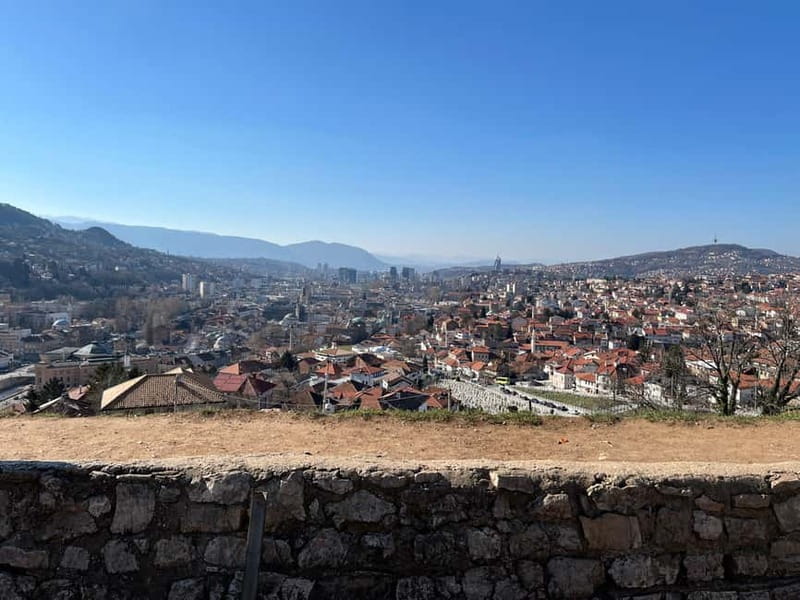
Morića Han introduces another part of Ottoman Sarajevo. A han was a place where merchants and other travelers could stay, rest, and conduct business. Here, the guide can help you picture the commercial life that once linked Sarajevo with wider trade routes.
This stop is useful because it shifts the focus from religious buildings to commerce and social life. Sarajevo’s old center was not only a place of worship. It was also a place where goods, stories, and people moved through the city.
The pace here is likely to be a guided look rather than a long independent visit. If you enjoy architecture and historical detail, keep your ears open and ask questions. The guides are expected to discuss history, construction, culture, customs, and food, so this is a good moment to ask about whichever part interests you most.
City Hall and Sarajevo’s Austro-Hungarian face
Sarajevo City Hall is another major landmark on the route. Its presence helps show the city’s later architectural and political changes. After the Ottoman-era sites, the building gives you a different visual language and another chapter in Sarajevo’s past.
The tour works well when you pay attention to those changes. You are not simply collecting famous buildings. You are seeing how different governments, religions, and artistic styles left their mark within a relatively small area.
The guide will likely keep you moving, since the full route includes many photo stops. That is a fair trade for a first look at Sarajevo. You get a broad orientation, then you can return later to the places that deserve more time.
Kazandžiluk and the sound of copper
Kazandžiluk is one of the most distinctive stops. This street is tied to Sarajevo’s copper-crafting tradition, said here to reach back about 500 years.
This is where the tour becomes hands-on. You can learn how the craft fits into local life and may even try it yourself. That small practical element adds something a standard sightseeing walk cannot provide. You are not only hearing about an old trade. You get a brief sense of the skill behind the objects sold in the old town.
Use this stop to look closely at the work rather than treating the shops as a quick shopping backdrop. Copper goods can be attractive souvenirs, but the bigger value is understanding why the craft belongs to Sarajevo’s identity.
Baščaršija, Sebilj, and the old town’s character
The route reaches Baščaršija, Sarajevo’s best-known old-town area, and the Sebilj fountain. These are likely to be among the most photogenic parts of the walk, with narrow streets, traditional shops, and a strong sense of the Ottoman-era center.
Sebilj also serves as the finishing point. The route lists it both as an early photo stop after the café and as the final meeting point, so the tour loops through the central old town before ending here. That is convenient if you want to continue exploring, shop for copperware, or find a place to eat afterward.
Baščaršija is also where the tour’s food and coffee themes make the most sense. The surroundings connect craft, trade, hospitality, and local eating habits. It is easy to hurry through this area for photographs, but I would keep a little time after the tour to wander at your own pace.
Bosnian coffee, baklava, and a 20-minute pause
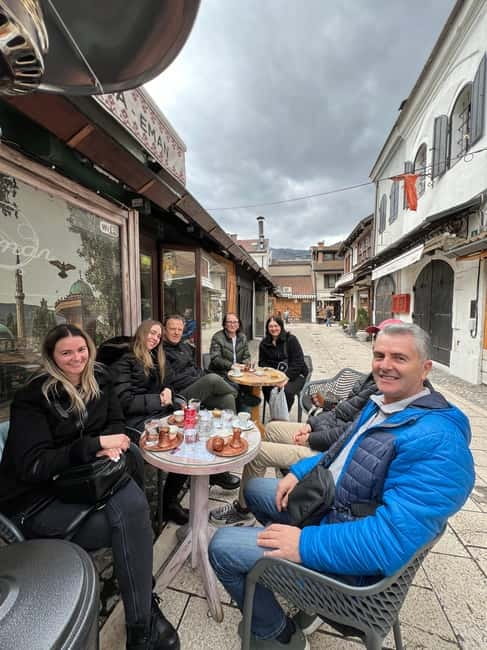
The café stop lasts about 20 minutes and includes Bosnian coffee served in the traditional way. This is not simply a caffeine break. Coffee is part of social life in Bosnia and Herzegovina, and the serving style gives you a small look at local custom.
You also have the chance to try traditional sweets, including baklava. The supplied details specifically include traditional sweets in the experience description, while the itinerary confirms the coffee tasting. If sweets are a priority, ask your guide what is available that day.
I like this pause because it breaks up the historical material. Three hours of monuments and dates can blur together. A short café stop gives you time to ask questions, compare notes, and experience something ordinary and local.
Do not expect the coffee break to function as a full meal. It is a tasting and rest stop, not a substitute for lunch. If you need more food, plan to eat before or after the walk.
The final panoramic view
The tour ends with a special viewpoint overlooking Sarajevo, with about 15 minutes set aside for the scenic stop. After walking through tightly packed streets, this wider view helps you understand the city as a whole.
The viewpoint is valuable because Sarajevo’s geography is part of its character. From above, you can better connect the old center, the surrounding hills, and the city’s broader shape. The exact location is not specified, so you should not assume a particular famous lookout or a long stop. Think of it as a short closing view rather than a separate sightseeing excursion.
This final pause also gives the tour a clean ending. You start with a monument in the central city, move through its religious and historical layers, taste coffee, see traditional craft, and finish by looking back over Sarajevo.
What $20 gets you
At $20 per person, the tour offers good value if you want a first introduction to Sarajevo. The fee includes a local English-speaking guide, Bosnian coffee, and the panoramic view. It also gives you a structured route through many of the city’s most important sights.
The value comes mainly from the guide. Without context, the Eternal Flame, Latin Bridge, religious buildings, Morića Han, and City Hall can become a long sequence of photo stops. A strong guide connects them into one story.
The feedback about the guides is consistently warm. Daniella has been praised for being friendly, helpful, and informative. Dijana has been credited with answering questions about history, architecture, culture, customs, and food, then suggesting what else to see. Amela has been praised for explaining both religious cooperation and Sarajevo’s wartime suffering, including her own experience of the most recent war.
Those details suggest that questions are welcome. If you want only a quick walk and a few photographs, the tour may cover more history than you need. If you want the city to make sense, the price is reasonable.
Timing, languages, and who should book
The standard public tour meets daily at 10 a.m. Private groups can arrange a different setup, and the guide can offer free hotel pickup or collection from an agreed address for a private booking.
The live tour is offered in English, Croatian, Serbian, Serbo-Croatian, and Bosnian. Private groups are available, which may suit families or friends who want more control over the pace and questions.
You should plan for 150 minutes to three hours. The wide time range matters because guided walking tours can move at different speeds depending on the group and the number of questions. Wear comfortable shoes, check the forecast, and dress appropriately.
Free cancellation is available up to 24 hours before the tour, and you can reserve now and pay later. Those terms are useful if your Sarajevo plans are still shifting. The tour is also listed as wheelchair accessible, though anyone with specific mobility needs should confirm the practical route before booking.
Should you book this Sarajevo walking tour?
Book it if you want a broad, human introduction to Sarajevo in one morning. It suits first-time visitors, history fans, people curious about religious and cultural connections, and anyone who likes pairing landmarks with coffee, sweets, and local craft.
I would especially choose it early in a Sarajevo stay. The guide’s tips about what else to see can help you plan the rest of your time, and the route gives you a useful map of the old center.
Skip it if you prefer exploring alone, spending a long time inside each building, or avoiding a set walking pace. For $20, though, the combination of local storytelling, Bosnian coffee, copper-craft tradition, and a panoramic finish makes this a practical and personal way to get oriented.
FAQ
Where does the Sarajevo walking tour begin?
The regular tour begins at the Eternal Flame monument, also called Vječna vatra, at 10 a.m. Look for a Sarajevo Experiences guide wearing a Sarajevo Experiences T-shirt or holding a Sarajevo Experiences umbrella.
How long does the tour last?
The tour lasts between 150 minutes and three hours. The exact timing can vary, so check availability when selecting a start time.
What is included in the price?
The $20 price includes a guided walking tour, an English-speaking local guide, Bosnian coffee, and the panoramic view of Sarajevo.
Is Bosnian coffee included?
Yes. The tour includes a traditional Bosnian coffee experience at a local café, with about 20 minutes set aside for the break.
Does the tour include baklava?
Traditional sweets are part of the experience description, and baklava is specifically highlighted. Ask the guide what sweet is available during your visit.
Which languages are available?
The live guide can provide the tour in Croatian, English, Serbian, Serbo-Croatian, or Bosnian.
Can I cancel or pay later?
You can cancel up to 24 hours before the tour for a full refund. You can also reserve your place and pay later, so you do not need to pay at the time of booking.
Just added around the world
- Vietnamese Coffee Making Class in Hoi An★ 5.0 · 4 reviews
- Venice Delights: Coffee & Food Experience Walking Tour★ 5.0 · 2 reviews
- Yerevan: Private Coffee Tour with 2 Café Stops★ 5.0 · 2 reviews
- Vietnamese Coffee 101 Workshop★ 5.0 · 11 reviews
- Ubud: Waterfall, Holy Water Temple,Swing&coffee plantation★ 5.0 · 9 reviews
- Vancouver: Street Art & Craft Coffee Walking Tour w/ Tasting★ 4.8 · 11 reviews
- Vienna: Guided Viennese Coffee-House Tour★ 5.0 · 2 reviews
- Coffee pleasure walking tour★ 5.0 · 12 reviews
Bosnia and Herzegovina Coffee Tours, compared.
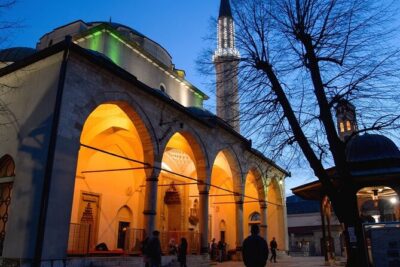
Private Walking Tour, Food Tasting and Bosnian Coffee in Sarajevo
Read our review →