

REVIEW · HO CHI MINH CITY COFFEE TOURS
Coffee Workshop in Ho Chi Minh City: Discover the art of coffee
Vietnamese coffee is more than a strong morning jolt. This two-hour workshop in Ho Chi Minh City takes you from coffee cherry to finished cup, with hands-on work in processing, roasting, tasting, and brewing. I like the chance to handle real coffee fruit and green beans, and I especially like that you finish by making coffee with a traditional phin filter. The small group, capped at 15 people, should also give you more room to ask questions.
The main caution is that this may feel more technical than a casual coffee tasting. The material follows the SCA’s Introduction to Coffee program, and one participant found the class scientific and the English difficult to follow with younger instructors. If you simply want a few easy tips for making better coffee, this could be more classroom than café outing.
Key points to know before booking
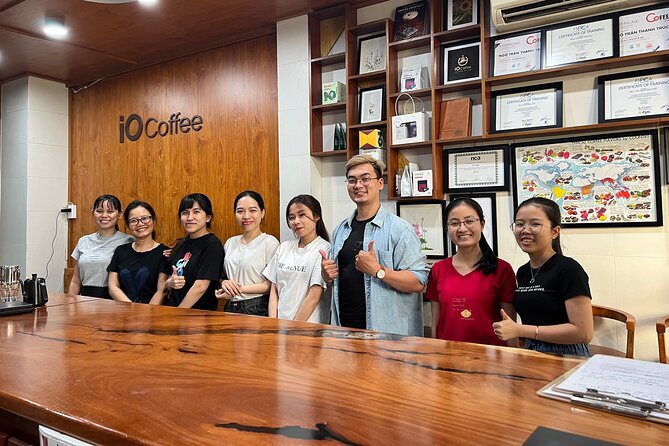
- You work with coffee at several stages: See coffee cherries, process green beans, roast samples, taste different levels, and brew a Vietnamese phin coffee.
- The class focuses on Fine Robusta: You learn why Vietnam’s signature bean can produce more than the very strong, sweet coffee many people first associate with the country.
- It is genuinely hands-on: You select defective green beans, take part in roasting, and make your own cup rather than only watching a demonstration.
- The group is limited to 15 people: That is a useful size for a practical class, though the experience can vary with the instructor and group.
- Chris and Danny have received strong praise: Chris adapted well when he had only one participant, while Danny was noted for his patience and clear explanations.
- The $71 price buys instruction, not just drinks: It makes the most sense if you value coffee education and want skills you can use at home.
Starting in Phu My Hung, District 7
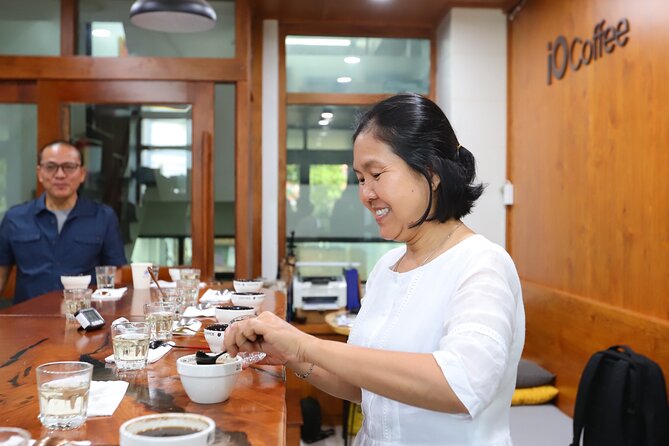
The workshop begins at The Signature M7 in Phu My Hung, District 7, at the lobby of Block A and B. That location matters because it is not in the central sightseeing area usually associated with a first visit to Ho Chi Minh City. You will want to allow enough time to reach District 7 and arrive ready for a class, not squeeze it between two rushed city-center stops.
The activity returns to the same meeting point. A mobile ticket is accepted, confirmation arrives at booking, and the location is near public transportation. Service animals are allowed. Those details are simple, but useful when you are planning a day around the workshop.
The two-hour length is well judged for the subject. Coffee can become technical fast, so a short class gives you a clear path from plant to cup without turning the whole day into a professional training course. Still, the exact feel depends on the instructor and the number of people present. One person received an almost private session, while the maximum group size is 15.
More Coffee Making Classes in Ho Chi Minh City
- Fun & Easy Vietnamese Coffee Workshop in Hồ Chí Minh City
★ 5.0 · 293 reviews - Ho Chi Minh City: Fun and Easy Coffee Workshop for Beginners
★ 4.9 · 121 reviews - Ho Chi Minh City: Coconut/Eggs Coffee Making Class
★ 5.0 · 8 reviews
Coffee farming starts with the fruit
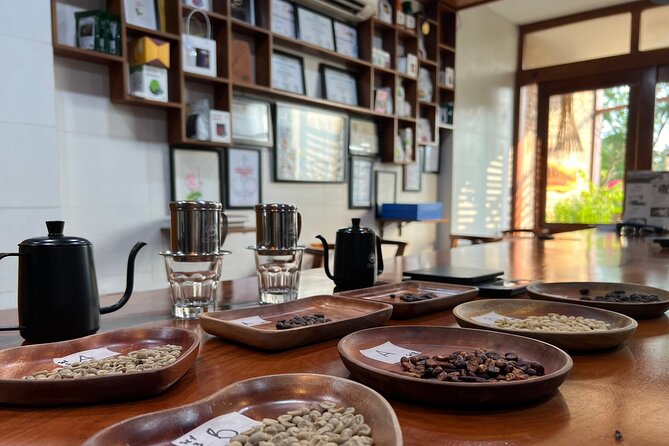
The first section looks at coffee before it becomes a roasted bean. You learn about harvesting and how ripe coffee cherries are selected. The workshop lets you see the structure of the fruit itself, then handle and peel coffee cherries and green beans.
That physical contact is one of the best reasons to choose this class. Coffee usually reaches you as a ground powder or a neat bag of beans. Here, you get a clearer sense of what the product looked like before roasting changed its color, texture, and smell.
You also see a small-scale demonstration of three coffee processing methods. Processing is the step between picking the cherry and preparing the green seed for roasting. The class does not simply present coffee as an agricultural product. It shows how choices made after harvest affect what eventually appears in your cup.
The bean-selection exercise adds a useful practical lesson. You inspect green beans and remove defective ones yourself. That helps you understand how quality control works, and it gives you a simple skill you can apply when looking at unroasted coffee.
I like this part because it avoids treating Vietnamese coffee as a ready-made cultural prop. You see the work behind the drink. The one limitation is time. In a two-hour program, the farming section can only give you an introduction rather than a full account of growing regions, farm economics, or seasonal harvesting.
Roasting three levels of coffee
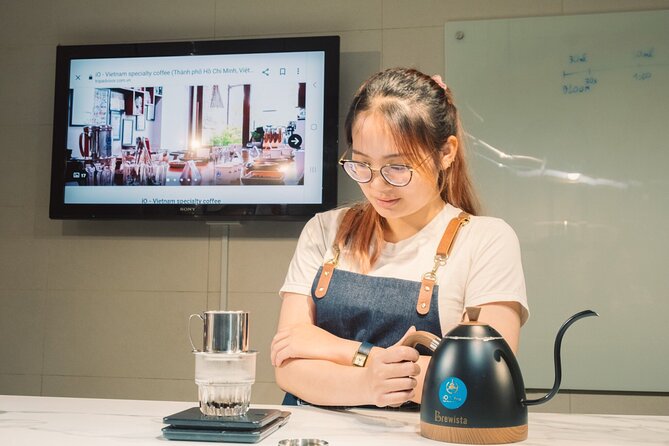
Next comes roasting, where the green bean changes into something recognizable as coffee. The class includes hands-on roasting and compares three roast levels. That comparison gives you a direct way to notice how heat affects flavor.
A darker roast can suggest a stronger, heavier cup, while a lighter roast can preserve different aromas and sharper notes. The point here is not to declare one roast best. It is to help you identify what you actually enjoy.
That personal element is important. Many people order coffee by habit, especially in Vietnam, where condensed milk and strong brewing can dominate the cup. Comparing three roast levels helps separate your preference for roast character from your preference for sweetness, milk, or brewing method.
You should expect some technical explanation. The class is connected to the SCA’s Introduction to Coffee program, so it is not designed only as entertainment. If you like understanding how coffee changes under heat, that structure is a strength. If you want a relaxed tasting with little terminology, it may feel more serious than expected.
One criticism worth taking seriously concerns instruction in English. An attendee found a young instructor difficult to understand. That does not mean every class has the same problem, especially since Chris and Danny were praised for being patient, funny, or adaptable. Still, clear communication matters in a technical workshop, so this is a fair consideration for anyone who depends on detailed English instruction.
Cupping gives you a better palate
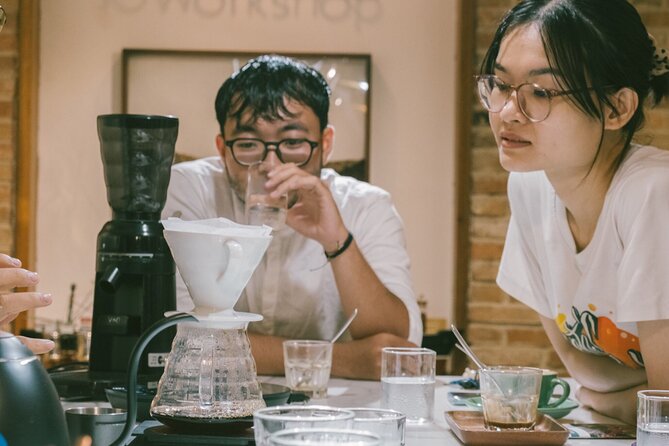
The tasting section, often called cupping, brings the roast comparisons together. You taste coffee at different roast levels and look for changes in flavor. This is more useful than simply being told that coffee has certain notes. You get a chance to compare cups side by side.
I find this kind of tasting valuable for beginners because it slows you down. Instead of drinking coffee quickly, you pay attention to aroma, body, acidity, bitterness, and aftertaste. The class is intended to help you tell lower-quality coffee from higher-quality coffee, so the exercise also has a practical shopping benefit.
The process can be especially helpful if your idea of Vietnamese coffee is limited to an intense, sweet glass served over ice. Vietnamese coffee culture includes that familiar style, but the workshop points you toward the bean itself and the choices made during roasting and brewing.
The tasting is not presented as a restaurant-style coffee flight. It is part of a lesson. You should be ready to listen, compare, and form your own opinion. The reward is a better understanding of why two cups made from the same general type of bean can taste quite different.
More Coffee Making Classes in Vietnam
- HCMc Egg Coffee Class in 1 hour with local intructor & snack
★ 4.2 · 8 reviews - HCM: Egg Coffee Class with local Instructor & Snack
★ 4.7 · 8 reviews - Drip Craft Coffee Workshop-Discover 4 Famous Types of Viet Coffee
★ 5.0 · 2 reviews - Hanoi Coffee Workshop: Taste Salt, Coconut and Egg Coffee
★ 5.0 · 1,286 reviews
Brewing with a traditional phin filter
The final stage is the most directly useful for home coffee drinkers. You learn how to brew Vietnamese phin coffee using the small metal filter traditionally placed over a cup or glass. The method is slower than an automatic machine, which is part of its appeal.
You prepare an authentic Vietnamese-style cup and learn how brewing affects the flavor of Fine Robusta beans. The class connects the earlier sections in a satisfying way: you have seen the raw fruit, handled green beans, roasted coffee, tasted roast levels, and now use the finished product.
This is also where the workshop becomes most practical. You can take the method home and repeat it. Unlike a short café demonstration, you leave with a process rather than only a memory. The class description does not specify every brewing recipe or equipment detail, so you should not expect a full manual covering every variation. It does promise instruction in the traditional method and a chance to brew your own cup.
The phin is a good fit for people who enjoy coffee as a small ritual. It does not demand expensive equipment, and it encourages patience. If you already use a French press, pour-over, or espresso machine, you may enjoy comparing the phin’s slow filtration with your usual method.
What the class does well
The strongest feature is its complete farm-to-cup sequence. Many coffee activities stop at tasting. This one gives you a basic picture of farming, processing, roasting, cupping, and brewing in one compact session.
I also like the level of contact with the materials. You do not just hear about coffee cherries. You see their structure. You do not just hear that poor beans can affect a batch. You pick out defects. You do not just receive a finished drink. You roast and brew.
The instructors can add a lot to the experience. Chris was praised for adapting the class to a single participant, which suggests the teaching can become personal when the group is small. Danny was praised for patience and clear explanations. Those names are useful to keep in mind, though instructor availability can change.
The 94 percent recommendation rate and 4.9 rating from 35 reviews point to a consistently positive experience, but I would read those numbers alongside the one clear warning: the workshop is not necessarily a simple introduction for someone who wants only quick brewing tips. Its value rises if you are curious about process and flavor.
Where the $71 price makes sense
At $71, this costs more than buying several coffees at local cafés. You are paying for guided instruction, ingredients, tasting, practical activities, and a small group rather than for one drink.
I think the price is fair if you plan to use what you learn. The class covers several stages of coffee production, and the phin method can become part of your routine after you return home. The value is less convincing if you only want to sample Vietnamese coffee or take a quick break from sightseeing.
The small group helps justify the cost. A maximum of 15 people is not the same as a private lesson, but it is manageable for a hands-on class. You have a better chance to see demonstrations, handle the materials, and ask about brewing than you would in a large lecture.
The best value may come when the group is smaller. One participant ended up alone and received a personalized class with Chris. You cannot count on that arrangement, but it shows how the format can work particularly well when attendance is light.
Who should book this coffee workshop?
I would recommend it to coffee drinkers who want to understand what they are tasting. It is a good match if you are curious about Robusta, want to compare roast levels, or hope to reproduce Vietnamese phin coffee at home.
It also suits people who prefer a practical activity to a standard city tour. You will use your hands, make choices, and taste the results. That makes the class more memorable than a simple talk about Vietnamese coffee.
You may want to skip it if your main goal is a casual café stop. The material can be scientific, and the workshop may discuss coffee with more seriousness than you expect from a holiday activity. Anyone who needs very clear English instruction should also keep the language concern in mind, although the experience with Chris and Danny was strongly positive.
The activity is also a good option for a repeat visitor who has already seen Ho Chi Minh City’s major sights. District 7 requires some planning, but the workshop gives you a different view of Vietnam, one based on agriculture, craft, and everyday drinking habits.
Booking, timing, and cancellation details
The workshop lasts about two hours and ends where it begins, at The Signature M7 in District 7. The mobile ticket makes arrival straightforward, and confirmation is provided when you book.
You can cancel for a full refund if you do so at least 24 hours before the local start time. Cancellations or changes made within 24 hours are not refunded or accepted. Service animals are allowed, and the activity is near public transportation.
My booking advice
Book this workshop if you want more than a cup of coffee. The hands-on farming section, three roast comparisons, cupping, and phin brewing create a clear and useful introduction to Vietnamese coffee. I especially like that you can take the final brewing skill home.
Think twice if you want an easygoing tasting with minimal technical detail. The workshop may suit a serious coffee beginner better than someone who only wants a few casual tips. For the right person, though, $71 buys a focused lesson and a much better understanding of what is in that small metal filter.
FAQ
Where does the coffee workshop take place?
It takes place at The Signature M7, in the lobby of Block A and B, in Phu My Hung, District 7, Ho Chi Minh City.
How long does the workshop last?
The activity lasts approximately two hours.
What happens at the end of the workshop?
The activity ends back at the meeting point at The Signature M7.
How many people can join?
The workshop has a maximum of 15 participants.
Will I make Vietnamese coffee during the class?
Yes. You learn to brew Vietnamese phin coffee with a traditional phin filter.
What coffee activities are included?
The class covers coffee farming, green bean processing, roasting, tasting, and brewing. You also handle coffee cherries and green beans, remove defective beans, and compare three roast levels.
Is the workshop suitable for learning about Robusta coffee?
Yes. The class focuses on Vietnam’s Fine Robusta beans and explains how they move from farm to cup.
Can I cancel for a full refund?
Yes, if you cancel at least 24 hours before the experience start time. Cancellations within 24 hours are not refunded, and changes within that period are not accepted.
Just added around Ho Chi Minh City
- Tea & Coffee Experience★ 5.0 · 10 reviews
- Saigon Special Night Coffee Landmark 81 & Food Tour★ 5.0 · 2 reviews
- Hands-on making 3 Iconic Coffees of South Central North Vietnam★ 5.0 · 14 reviews
- Private Ho Chi Minh City Tour from Port & Vietnamese Egg Coffee★ 5.0 · 6 reviews
- Sai Gon Special Coffee At Landmark 81 & Street Food tour★ 5.0 · 3 reviews
- Drip Craft Coffee Workshop-Discover 4 Famous Types of Viet Coffee★ 5.0 · 2 reviews
- Discover Vietnam’s Coffee Culture.★ 5.0 · 5 reviews
- [Free E-sim] Half day Instagram Cafe Tour in Ho Chi Minh★ 4.5 · 8 reviews
Ho Chi Minh City Coffee Tours, compared.
Egg coffee & Course on 4 traditional types of Viet coffee
Read our review →
Fun & Easy Vietnamese Coffee Workshop in Hồ Chí Minh City
Read our review →
Vietnamese Coffee & Culture Exploration in Hồ Chí Minh City
Read our review →
Decadent Vietnamese “Egg Coffee” Workshop in Hồ Chí Minh City
Read our review →

Techniques & Secrets Behind the Famed Vietnamese Egg Coffee
Read our review →
1 hour Egg Coffee Cooking Class with Snack and Local Instructor
Read our review →
Saigon Unseen: Culture, Coffee, Hidden Spots Motorbike Adventure
Read our review →Browse the lists this tour appears in